Learning Physical Systems
How can machines learn the structure and dynamics of physical systems?
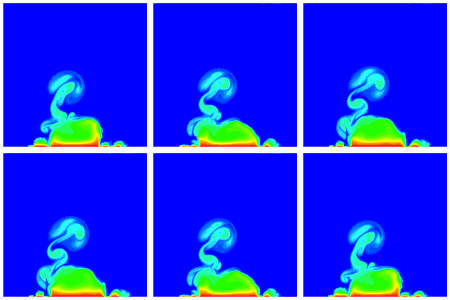
We develop neural operators, generative models, transformers, and foundation models for scientific prediction. We study how these models represent spatiotemporal dynamics, generalize across physical regimes, and learn representations that extend beyond the conditions seen during training.
Physics-Constrained Learning
How can physical knowledge be incorporated into learning systems?
We develop learning-based models for fluid dynamics, heat transfer, multiphysics, and phase change systems. We investigate methods to encode conservation laws, geometry, and other physical constraints into learned models, and how to construct models whose predictions remain consistent with fundamental physical principles.
Computing at Scale
How can we make scientific AI scale?
We develop algorithms, GPU kernels, and efficient architectures for the computational bottlenecks underlying scientific AI. Our work spans attention, memory-efficient computation, and scalable training and inference, enabling models that would otherwise be computationally impractical.